By AIProSpace Team · Updated Apr 13, 2026
Best AI & Business Books in 2026
Whether you're leading a team or running a company, these are the AI business books worth reading. Focused on strategy, economics, and real-world application.
Best AI Books — Quick Reference Table
| # | Title | Author | Rating |
|---|---|---|---|
| 1 | Prediction Machines | Ajay Agrawal, Joshua Gans, Avi Goldfarb | 4.1 ★ |
| 2 | AI Superpowers | Kai-Fu Lee | 4.3 ★ |
| 3 | A World Without Work | Daniel Susskind | 4.1 ★ |
| 4 | Power and Prediction | Ajay Agrawal, Joshua Gans, Avi Goldfarb | 4 ★ |
#1
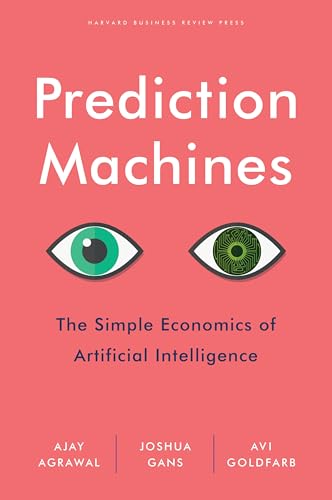
Prediction Machines
by Ajay Agrawal, Joshua Gans, Avi Goldfarb · April 17, 2018
Three economists reframe AI as a technology that dramatically reduces the cost of prediction, and explain what this means for strategy, management, and the economy.
My Take
Prediction Machines is the most useful business AI book I have read. The central insight — that AI is fundamentally a prediction technology, and cheap prediction changes everything — is simple and powerful. The authors are economists, so they think carefully about incentives and tradeoffs rather than just listing applications. The strategy implications for businesses are concrete and actionable. Best for executives, managers, and entrepreneurs who want to think clearly about AI's business implications.
#2
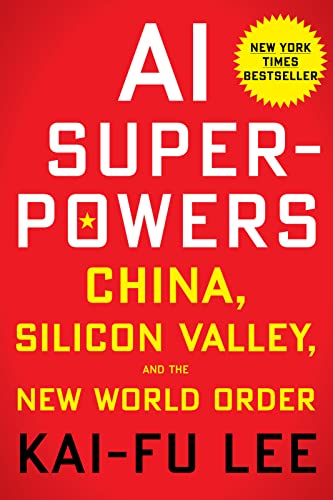
AI Superpowers
by Kai-Fu Lee · September 25, 2018
The former head of Google China argues that the AI race between the US and China will reshape the global economy, and explains why China may have structural advantages in AI deployment.
My Take
Kai-Fu Lee brings a unique perspective — he has led AI labs in both Silicon Valley and Beijing. His argument that China's massive data advantage and willingness to deploy AI aggressively could outweigh the US's research edge was controversial in 2018 and remains debated today. Regardless of whether his predictions prove correct, the framework is useful: implementation advantage vs. research advantage is a real distinction. Best for anyone thinking about AI geopolitics and competitive strategy.

#3
A World Without Work
by Daniel Susskind · January 14, 2020
An Oxford economist challenges the assumption that new jobs will always replace those lost to automation, and asks how society should be organized if machines can do most human labor.
My Take
Susskind is more rigorous and more pessimistic than most economists who write about automation. He takes seriously the possibility that this wave of technological unemployment could be different from previous ones, and spends most of the book asking what we should do if that is true. The policy proposals are practical and the economic reasoning is clear. Best for anyone thinking seriously about AI's impact on employment and economic policy.
#4
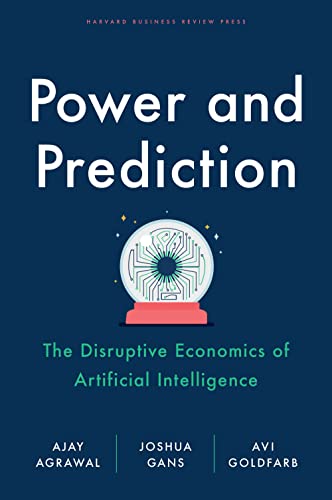
Power and Prediction
by Ajay Agrawal, Joshua Gans, Avi Goldfarb · November 15, 2022
The sequel to Prediction Machines examines how AI will disrupt existing power structures in industries, governments, and professions by challenging the judgment of experts.
My Take
Power and Prediction builds productively on Prediction Machines, focusing specifically on how cheap AI prediction will redistribute power between those who currently make judgments and those who do not. The healthcare chapter — examining how AI diagnosis tools will shift power from physicians — is particularly sharp. Less immediately useful than its predecessor but essential reading for anyone thinking about strategic implications of AI at an industry or institutional level.
Frequently Asked Questions
What is the best AI book for beginners?
The Worlds I See by Fei-Fei Li is the best starting point — it tells the story of modern AI through a deeply personal memoir that requires no technical background. AI: A Guide for Thinking Humans by Melanie Mitchell is the best purely explanatory book for non-technical readers.
Which AI books are actually worth reading?
From this list, the essential reads are: The Worlds I See (for history and humanity), The Alignment Problem (for safety), Prediction Machines (for business strategy), Life 3.0 (for big-picture thinking), and Machines of Loving Grace (for what's happening right now).
What AI books do AI researchers recommend?
Researchers consistently recommend: Human Compatible (Stuart Russell) for foundational thinking on alignment, The Alignment Problem (Brian Christian) for an accessible deep dive, and Superintelligence (Nick Bostrom) for historical context on how safety concerns developed.
Are there good free AI books?
Several excellent AI books are freely available online. 'Artificial Intelligence: A Modern Approach' has partial content available. Many academic AI papers and textbooks are freely accessible on arXiv. The books on this list require purchase, but most are available at public libraries.